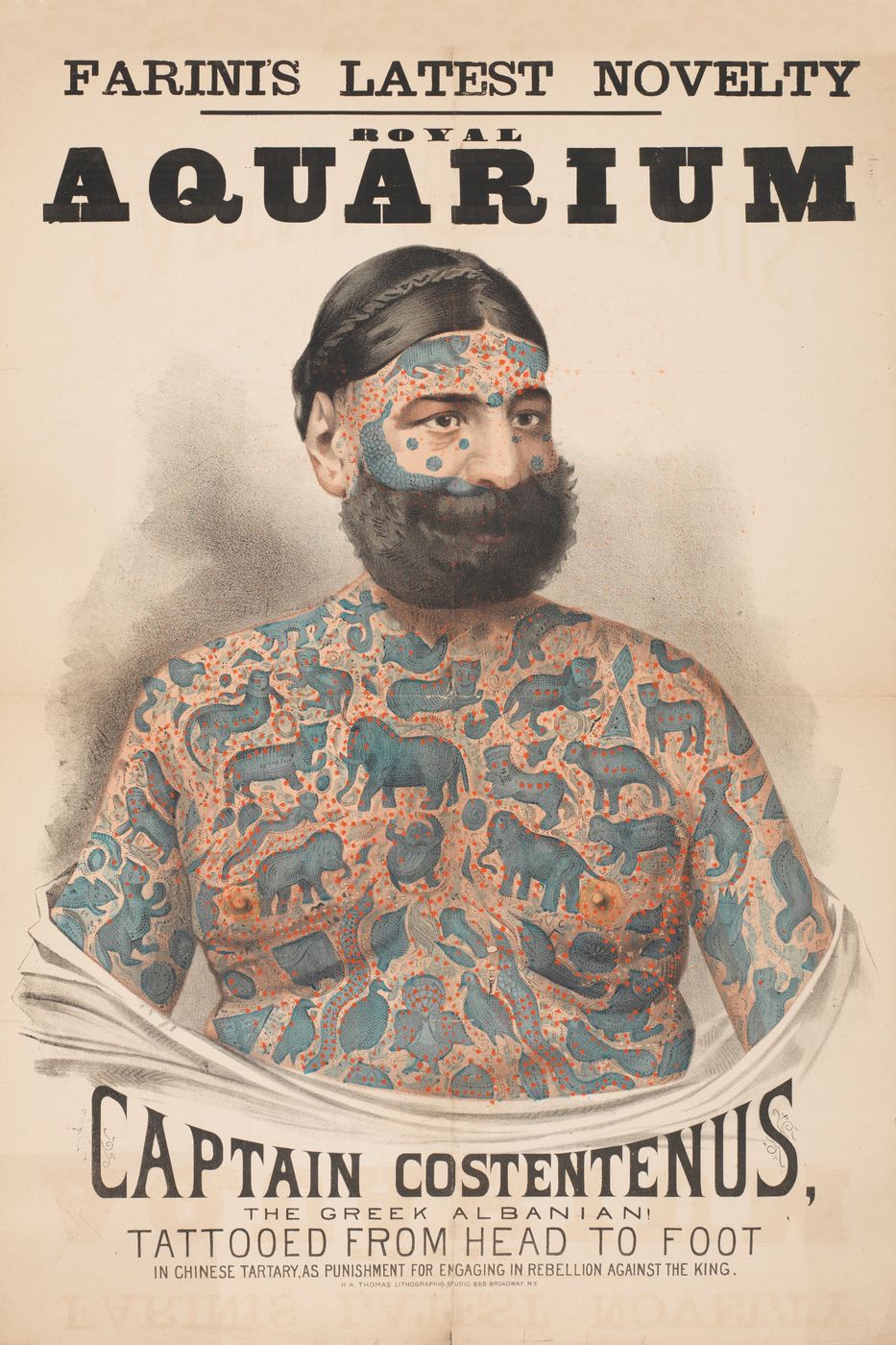
Captain Costentenus Tattooed Man Poster 1880s
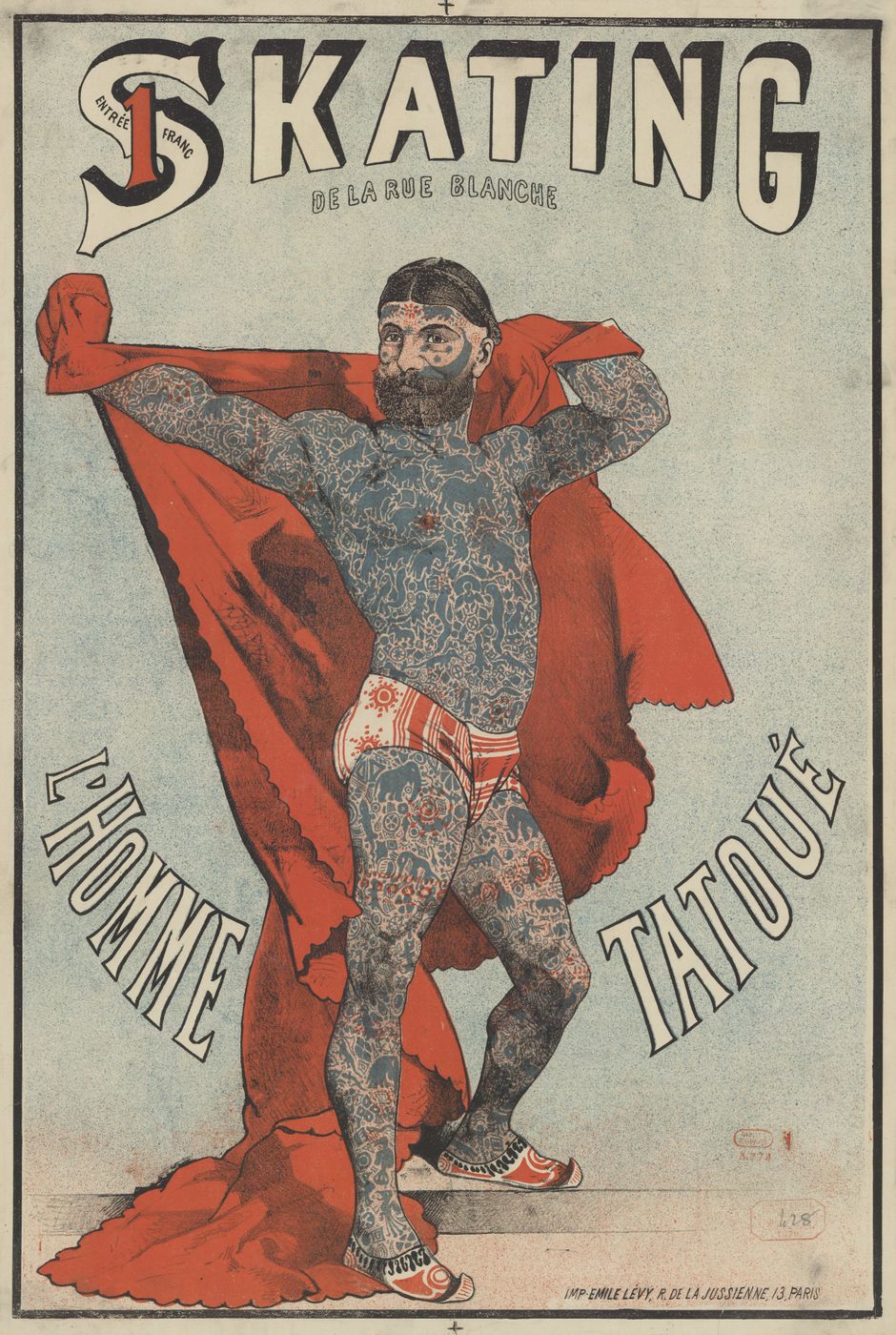
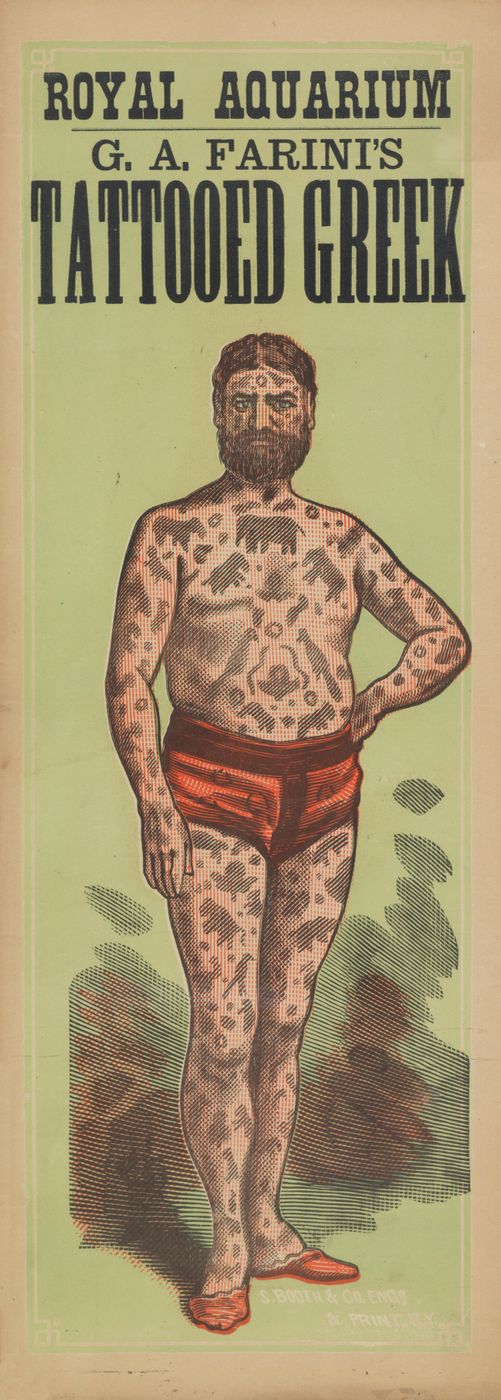
Buy this print on Etsy →Captain Costentenus, "the man tattooed from head to foot," was one of the most sensational human curiosities of the Victorian era, and this striking chromolithograph — printed in New York and issued for G. A. Farini's exhibition at the Royal Aquarium in London around the early 1880s — captures exactly why crowds queued to see him. The poster presents Costentenus from the waist up, his face, chest, and arms densely covered with an intricate blue-and-red network of tattooed elephants, monkeys, gazelles, serpents, birds, and other exotic beasts, framed by the bold Victorian display type that announced "Farini's Latest Novelty" at the "Royal Aquarium."
The story sold to the public was pure sideshow theatre. Costentenus — also recorded as Georgius Constantine, and billed variously as "the Greek Albanian" — claimed to be a nobleman captured during a military adventure in Chinese Tartary and Burma, where, as an alternative to execution, he was sentenced to be tattooed over his entire body. According to the legend printed on his handbills, the punishment took roughly three months, was carried out by six men, and left him marked with some seven thousand individual figures covering nearly every inch of skin, including his eyelids, ears, and the spaces between his fingers and toes. Historians now believe the more prosaic truth is that he was an Albanian who acquired his elaborate Burmese-style tattoos voluntarily, then wrapped them in an irresistible tale of captivity and cruelty for the stage.
Whatever the reality, his fame was immense. Managed by the celebrated showman Guillermo Antonio Farini — the tightrope artist and impresario born William Leonard Hunt — Costentenus was exhibited at the Royal Aquarium in Westminster and later toured North America with P. T. Barnum's circus, where he became one of the highest-paid sideshow attractions of his day, reportedly earning more than a thousand dollars a week at the height of his celebrity. He is often credited with helping to spark the late-nineteenth-century fashion for decorative tattooing among the European and American upper classes, who found in his fully illustrated body a strange, cosmopolitan glamour.
This poster is a faithful, museum-quality reproduction of the original lithograph, carefully restored from a high-resolution scan held in a major medical-history collection. The rich colour, the halftone shading, and the ornate period lettering have all been preserved, making it a genuine document of Victorian popular entertainment, circus history, and the early culture of tattooing. It is printed on premium archival matte paper with true-to-life colour and crisp detail.
A bold, conversation-starting piece for a living room, study, bar, tattoo studio, or any wall that could use a touch of nineteenth-century spectacle, this print pairs beautifully with other vintage circus, sideshow, and curiosity art. It makes a memorable gift for tattoo enthusiasts, collectors of the odd and antique, circus-history buffs, and anyone drawn to the strange, ornate visual world of the Victorian aquarium and its "living wonders."
The Royal Aquarium, opened in Westminster in 1876, was one of London's grandest halls of spectacle and variety — far more a palace of entertainment than a true aquarium — and Costentenus was among its star attractions, a reminder of an age when the lines between science, exhibition, and pure showmanship were gloriously blurred. Surviving posters like this are now treasured as vivid records of that lost world of popular wonder.